
Elderberry Time by Sarah Cheng
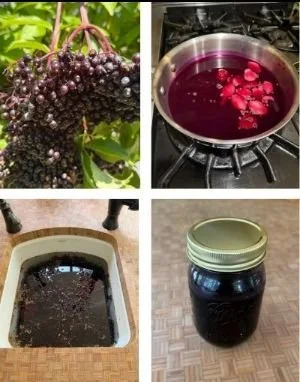
Late summer has seen an abundance of fruits and vegetables in the Heritage Garden. From our first year, we thought that an easy-to-grow shrub with medicinal value for pioneers should be part of our plant selection. This would be our Sambucus canadensis 'Nova' – the American black elderberry, native to eastern North America. Our native relatives are the blue and red elderberry (S. cerulea and S. racemosa). From very early times this deciduous shrub has been used for both musical instruments and for food in many places in the world. The Latin meaning for the word Sambucus refers to a harp or flute; the stem pith is easily removed to make a flute from the hollow remains. According to my ethnobotany booklet, indigenous local tribes collected the berries, but also used the stems to make elk whistles! We’ll have to try that in the HG.
For the past few years, we have harvested the Heritage Garden berries but hesitated to make donations to the food bank. The entire plant contains toxic cyanogenic glycosides, which are broken down by boiling stems, leaves and berries for at least 15 minutes. Extra care is needed when processing, and raw berries should not be eaten.
When you browse health food aisles, elderberry supplements are touted as beneficial for immune health – especially during cold and flu season. One year, Lena Wegner made a delicious elderberry dessert for our board meeting. Since then, I’ve come to appreciate our elderberries and each year make a syrup using Rosemary Gladstar’s recipe in her book Medicinal Herbs. With a few changes, (adding cinnamon and reducing the honey) I’ve found this recipe to be delicious and nutritious. For processing, the berries are much easier to remove from the stems by freezing first. Note that it’s important to strain the liquid after boiling to be sure all the seeds are removed. A second strain through cheese cloth keeps the liquid clear of residue. The syrup will last at least one month in the fridge due to the honey, or can easily be frozen.
The remaining deep purple liquid inspires confidence that your body will benefit. I regularly have one tablespoon with my breakfast every day, and if I start to feel an itchy throat or achy body, I increase my dosage to a tablespoon three more times during the day. Often those “I’m coming down with something” symptoms disappear. Is this a placebo effect? Does it really help? It can’t be guaranteed, but it's satisfying to have a tasty sweet sip, believing I’m “doing my body good”.