
Hop or Hops, the Plant I Love to Hate by Lena Wegner
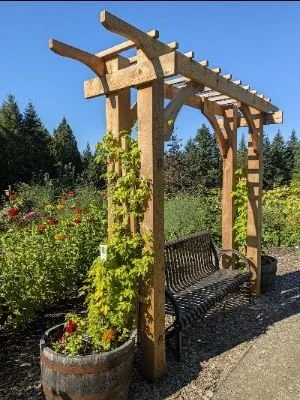
Hop plants and I have been fighting for 21 years, and here I am, not only writing about hops, but having bought four plants for the Heritage Garden! Why? I have not kept my hop feelings quiet, so the Board had its fun assigning me to write about Humulus lupulus, now that we added it to the HG.
I am not alone in my hop frustrations; they go back centuries and span many cultures. An indication of this lies in its name, “lupulus”, which means little wolf, an indication of its aggressive behavior towards anything near it; Pliny the Elder compared it to a “wolf strangling sheep”. The word “hop” is derived from the Anglo-Saxon hoppan which means to climb. And does it ever, vigorously, indiscriminately, tenaciously! It grows 33’ in a season (and lives 20 years), strangling anything it can reach. In my garden it has overpowered my trumpet vine arbor, a large lilac, my poor rhubarb, my gladiolas and my heather. My neighbor’s holly shrub and raised tomato bed are in its way! All it was supposed to do was cover a modest trellis to hide the neighbor’s garbage bins!
Tendrils of the ones we added to the HG, less than a month ago, have already reached the top of the arbor which they are supposed to cover. Why did we plant them, given their reputation? Hops have had and have a major impact on society, and pioneers grew it in this area. Hop plants are also beautiful and provide shade. We will control their aggression by confining them to whisky barrels that are set away from other vegetation.
Humulus lupulus is native to Western Asia and Europe. (North America has three native species, but they are not important in the history of hops.) Hop or hops, the terms are used inconsistently and interchangeably, grow in temperate zones like ours. It prefers well-drained, rich soil and sunshine. Our state is an important producer of hops, primarily grown in eastern Washington, including the Yakama Indian Reservation. It likes slightly acidic or neutral soils and average moisture. The plant is dioecious; the male flowers lack petals, and the female flowers are small cones. The plant is wind-pollinated. It dies back to its rhizomes each winter. In spring, the length of day determines when it starts regrowth and also when it blooms in summer.
Of course, beer has to be mentioned when talking about hops; beer rules its cultivation worldwide. Because of beer, only female plants are raised, since it is the female cones that are used in brewing. In the field, the plants are trained onto strings and high overhead trellises. Hop growing had far-reaching social consequences, with literature documenting the deplorable conditions harvesters endured. Harvesting is now mechanized.
On your next garden visit, look for this vigorous love/hate plant recently added to the arbors.