
Asparagus officinalis by Lena Wegner
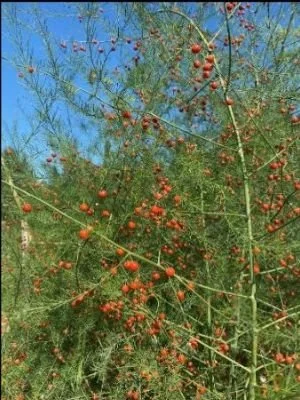
Asparagus officinalis is an old member of pioneer vegetable gardens; the plant has been grown from ancient times on. We know it was cultivated as early as 3000 BC, because it is pictured on an Egyptian frieze from that time. The genus is native to Eurasia where it is widespread. It likes coastal conditions best, and grows freely along the western coasts of Europe, from Spain to NW Germany. After introduction into North America, sometime before 1655, it became happy in the maritime environment of our west coast. It tolerates saline soil; when planted in the country’s interior, a little salt can be added to the soil to suppress weed growth.
The HG asparagus bed gets full sun, is well-drained, has slightly acidic soil and is rich in organic matter, all good conditions for growth. Asparagus appreciates “feeding”, and we supply nitrogen yearly.
A. officinalis, the cultivar used in home gardens, is a long-lived, flowering perennial which has been known to yield a harvest for up to 30 years! It normally grows four to five feet high, but can reach over 11 feet! It has stout stems and very fine, feathery, needle-like foliage. It can be planted from seed, crowns (root systems), or transplants. Crowns are most commonly used. They are usually one to two years old and establish quickly. The tiny, greenish white flowers are bell shaped. They are not very showy, but the bright red berries that follow on the female plants enhance the lovely, feathery foliage. (Asparagus is dioecious.) For a serious asparagus grower, it is almost universally recommended to grow all male plants as they yield a more abundant harvest. Full harvesting starts in the 4th season and lasts for eight to ten weeks. The young six to eight inch shoots are picked daily. In our area early April, or sometimes even late March starts the harvest which lasts through the end of June.
Tomatoes are recommended as companion plantings for asparagus. Planting the two together benefits both: the asparagus repels some root nematodes that affect tomatoes and the tomatoes repel the asparagus beetle.